Calling Foul
Defending religious liberty and putting Pennsylvania’s religious school students back on the field
This article originally appeared in the Thomas More Society 2025 Impact Report. To explore the full Impact Report, click here.
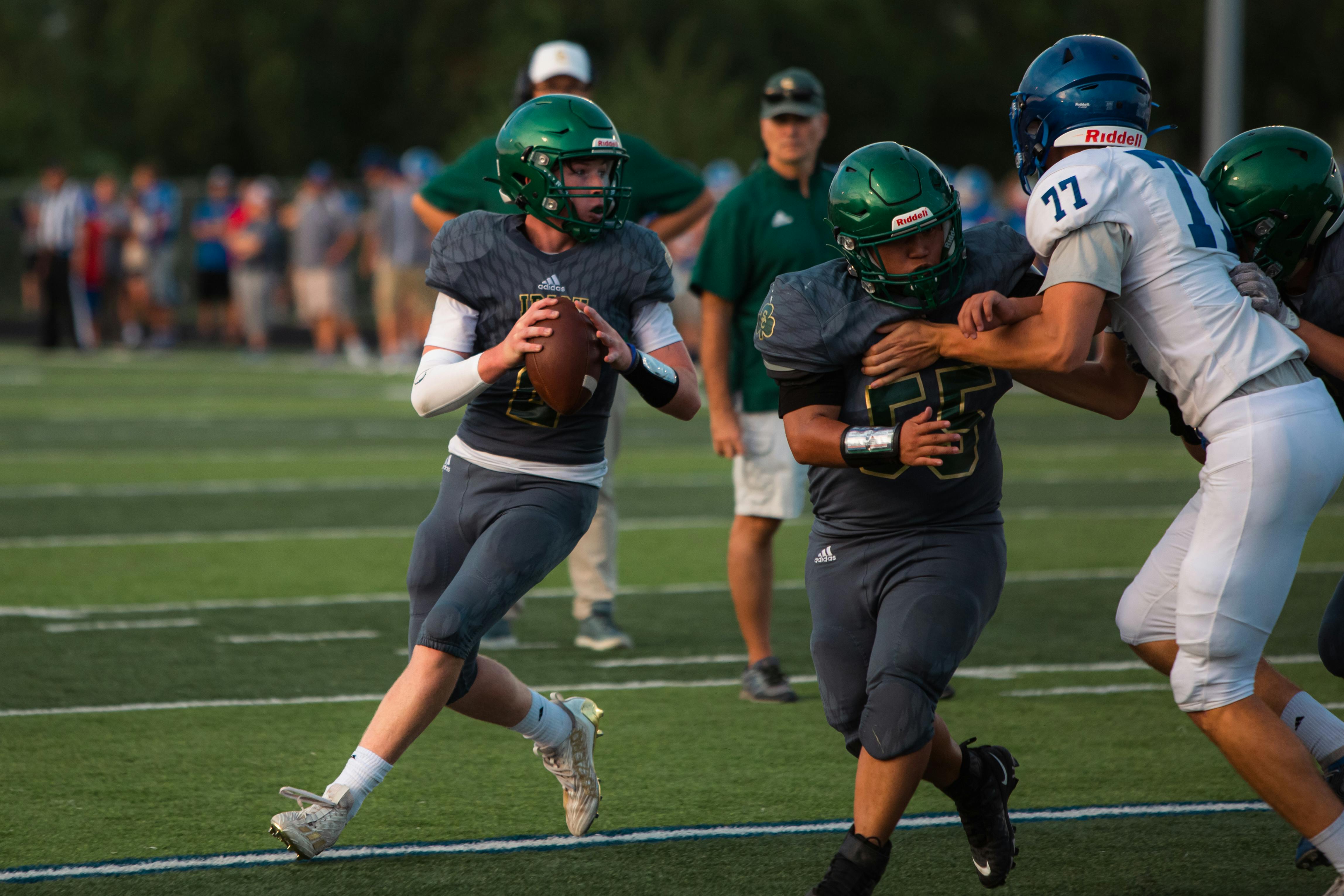
David Aungst’s son loved football. He had the talent and the drive. The only thing standing between him and a spot on the team was his family prioritizing faith in their educational choice.
Because the Aungsts had chosen a religiously-affiliated school for their son—one that didn’t have the budget for a football team—the door to playing at their local public school was shut in their face. It didn’t matter that they paid the same district taxes as every other family in the community. It didn’t matter that homeschooled students could play. It didn’t matter that charter school students could play. The Aungst family had chosen a religious education for their son, and under the bylaws of the Pennsylvania Interscholastic Athletic Association, or PIAA, that choice locked them out of taxpayer-funded resources.
As Justice Samuel Alito wrote for the Supreme Court’s majority in Mahmoud v. Taylor (2025), “for many people of faith across the country, there are few religious acts more important than the religious education of their children.” In Pennsylvania, families were being punished for exactly that.
An Uneven Playing Field
The PIAA governs middle and high school athletics across the Commonwealth. Under its bylaws, students at religiously-affiliated schools were barred from competing on their home public school district’s teams when their own school didn’t offer the sport. The exclusion swept across denominations—Catholic parochial schools, Christian academies, and other faith-based institutions alike. Any family who had chosen to root their child’s education in faith paid the price.
The carve-outs for homeschooled and charter students made the double standard impossible to ignore. Secular reasons for attending a non-public school earned an exemption. Religious reasons did not. For families of faith, the publicly funded playing field was open to everyone except them.
Thomas More Society filed its first federal lawsuit in July 2023 for a group of families, targeting the State College Area School District, which had been allowing charter and homeschool students to participate in extracurricular activities while turning away religiously-affiliated school families who paid the same taxes. TMS attorneys argued the policy violated both the Free Exercise Clause of the First Amendment and the Equal Protection Clause of the Fourteenth Amendment. The district’s exclusion was not neutral, not generally applicable, and not constitutional.
U.S. District Judge Matthew Brann agreed, denying the district’s motion to dismiss and writing plainly: “The Free Exercise Clause is clear: regardless of what reasons some parents may have for sending their children to a non-public school, a religious reason has the same value as a secular reason. If some exemptions are made, a school’s refusal to make a religious one enforces a value judgment preferring secular conduct over religious conduct.”
In June 2025, the State College Area School District settled, agreeing to open its extracurricular and co-curricular programs to eligible religiously-affiliated school students on the same terms as homeschooled and charter students. It was an important victory, but it was only one district. The real barrier was statewide.
A Statewide Win
Although the PIAA is a private association, it operates as an arm of the state. Its member schools are overwhelmingly public, it exercises authority delegated by Pennsylvania’s public school system, and its decisions carry the force of government policy. That makes it subject to the First Amendment just like any other state actor.
In July 2025, TMS filed a federal civil rights lawsuit against the PIAA itself, on behalf of several families across the state. The complaint laid bare the same unconstitutional double standard, now challenged at the statewide level.
The case moved quickly. On September 15, a federal court entered an Interim Consent Order confirming that students at religiously-affiliated schools throughout Pennsylvania could immediately join their local public school district’s teams in sports their own schools didn’t offer. The PIAA agreed to amend its bylaws to comply.
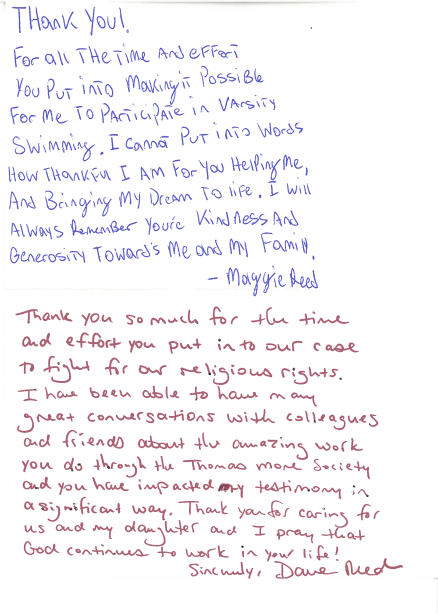
The impact was immediate. Families who had spent years sacrificing opportunities—prioritizing their children’s faith-based education over athletics—no longer had to choose. Among them was a young swimmer named Maggie, who earned a spot on her local district’s varsity swim team shortly after the ruling. Her thankful letter to the legal team that secured her a chance to compete says more than any court order could.
“Our family is deeply grateful to the Thomas More Society for standing up for families like ours,” David Aungst said after the ruling. “Because of their work, our son can now play football with his peers at our local public school without us having to sacrifice our faith, values, and educational freedom.”
No family should be penalized by the government for choosing to raise their children in faith. Thomas More Society’s litigation in Pennsylvania made that principle enforceable—first at the district level, then across the entire Commonwealth. For Pennsylvania’s families of faith, the playing field is finally level.