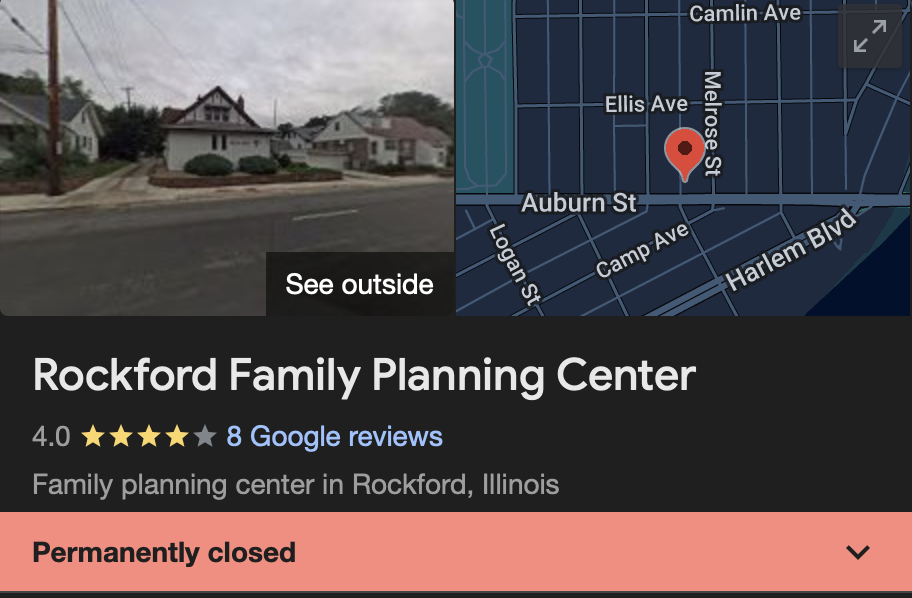
Closed
How we fought from zoning boards to state court to shut down an abortion business that menaced a neighborhood

This article originally appeared in the Thomas More Society 2025 Impact Report. To explore the full Impact Report, click here.
Rockford, Illinois is a city that has been fighting for itself. After decades of Rust Belt decline, its residents have been the engines of growth—converting abandoned factories into hotels, planting roots along the riverfront, starting new businesses, and investing in the kind of communities where families actually want to live.
In 2022, a Wisconsin abortionist that Rockford had already sent packing once before decided a quiet residential neighborhood was the perfect place to hide an abortion pill mill—not in a medical district nor in a commercial corridor, but a single-family street, tucked behind the paperwork of a permit that had expired in 1982.
Rockford's Repeat Offender
Dennis Christensen has spent decades at the outer edges of the abortion industry. In 1999, he was one of only two Wisconsin abortionists still performing late-term abortions, joining Planned Parenthood in a lawsuit to strike down the state’s partial-birth abortion ban. In 2013, when Wisconsin required abortionists to obtain hospital admitting privileges, three Milwaukee-area hospitals independently denied his applications. In a 2001 interview, he boasted of having ended more than 100,000 lives during his career, declaring: “When I meet my maker, I think she’s [sic] going to say, ‘Way to go!’” In the 2006 documentary Lake of Fire, he appears on camera examining the dismembered remains of a 20-week-old child he had just aborted.
“In a 2001 interview, he boasted of having ended more than 100,000 lives during his career…”
Rockford had already learned what he looked like up close. In 2011, his “Northern Illinois Women’s Health Center” was shuttered after a cascade of violations—improper record-keeping, inadequate post-surgical monitoring, physicians without hospital admitting privileges. The facility had gone 14 years without a state inspection, until a whistleblower nurse and a group of determined residents, represented by Thomas More Society, forced public health authorities to take a look. When they finally took a closer look, the facility was shut down.
Christensen was quiet for a while after that. Then Roe fell in 2022, and he saw an opening.
The 'Home Business' That Wasn't
He purchased a residential property on a single-family street and sought to convert it into an abortion facility—marketing it as an abortion tourism destination, with nearly half his patients traveling from out of state, since his home state of Wisconsin still had pro-life laws on the books. But he needed the city’s blessing. The Rockford Zoning Board provided it, ruling that Christensen could operate under a special use permit originally issued for a solo chiropractor’s home practice. Incredibly, that permit had expired in 1982. The Board had waved him through on a permission slip four decades out of date.
That wasn’t the only legally suspect discrepancy in this story. Christensen didn’t live at the property, he lived in Wisconsin. He wasn’t a solo practitioner working out of his home. He employed non-resident staff in a commercial operation that bore no resemblance to anything the permit had ever authorized. Under any ordinary reading of Rockford’s zoning code, this was not a home business.
Thomas More Society brought the fight back to the Zoning Board on behalf of the neighborhood’s residents, and then to the courts when the Board refused to budge—even refusing to recognize the residents’ legal standing to challenge the decision despite documented impacts on their property values. It was a frustrating result, but not a final one.
In March 2025, Thomas More Society Executive VP and Managing Counsel Joan Mannix argued before the Illinois Appellate Court for the Fourth District and dismantled the city’s baseless defense. That state appellate court issued a unanimous ruling: The Zoning Board’s approval was “clearly erroneous.” The for-profit abortion facility bore no legitimate relationship to the expired permit invoked to justify it. The city had no legal basis to let it operate.
Not Above the Law
“The Court’s ruling sends a crystal-clear message: zoning laws exist to protect our communities, and they must be enforced fairly and consistently—even when they impact the abortion industry,” said Peter Breen, TMS Executive VP and Head of Litigation. “Abortion businesses cannot set up shop wherever they want, including in the middle of quiet family neighborhoods.”
Christensen’s facility was required to shut down shortly after the ruling. For the residents of that Rockford street, it was a victory years in the making, won through hearings attended, rulings challenged, and a refusal to quit even when the courts initially turned them away. Thomas More Society was their legal voice, but the fight was theirs.
Lives will be saved in Rockford because ordinary people demanded that the law be applied equally—to everyone, even the abortion industry.